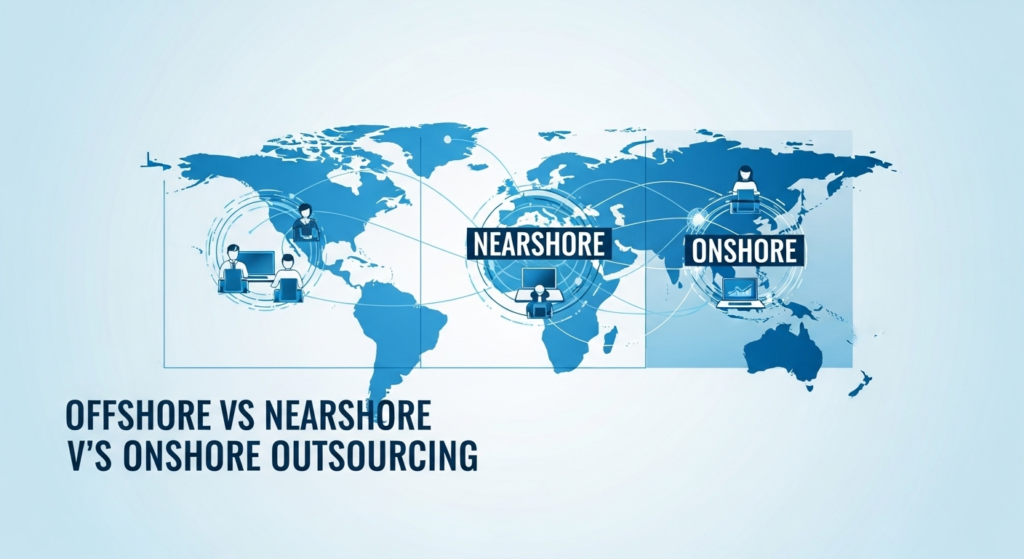
What’s the difference between offshore, nearshore, and onshore outsourcing, and which one is right for your business?
Outsourcing has become a powerful strategy for companies looking to reduce costs, access global talent, and scale faster. But choosing the wrong outsourcing model can lead to communication issues, delays, and unexpected expenses.
In this guide, you’ll learn:
- The exact differences between offshore, nearshore, and onshore outsourcing
- The pros and cons of each model
- How to choose the best option based on your business needs
What Is Outsourcing? (Simple Explanation)
Outsourcing is when a business hires an external team or company to handle specific tasks instead of doing them in-house.
Companies outsource to:
- Reduce operational costs
- Access specialized skills
- Scale quickly without hiring full-time staff
There are three main outsourcing models:
- Offshore
- Nearshore
- Onshore
Each comes with its own advantages and challenges.
What Is Offshore Outsourcing?
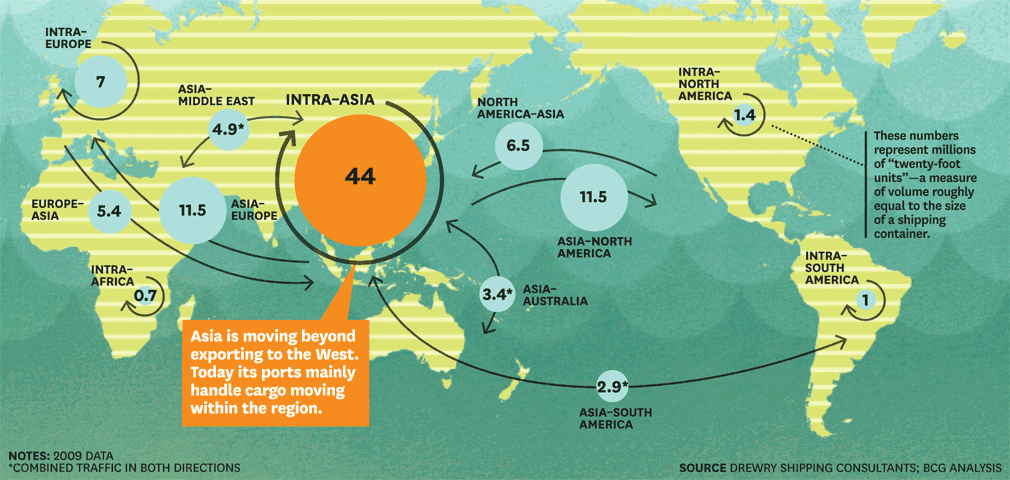
Offshore outsourcing means hiring a team in a distant country, often across continents (e.g., US outsourcing to India or the Philippines).
Advantages of Offshore Outsourcing
- Lower costs: Labor is significantly cheaper
- Access to global talent: Wider pool of skilled professionals
- 24/7 productivity: Time zone differences allow continuous work
Disadvantages of Offshore Outsourcing
- Time zone challenges: Delayed communication
- Language barriers: Misunderstandings may occur
- Quality control risks: Requires strong management
What Is Nearshore Outsourcing?

Nearshore outsourcing involves working with teams in neighboring or nearby countries with similar time zones.
Advantages of Nearshore Outsourcing
- Better communication: Minimal time difference
- Cultural compatibility: Easier collaboration
- Faster project turnaround
Disadvantages of Nearshore Outsourcing
- Higher costs than offshore
- Smaller talent pool compared to global markets
What Is Onshore Outsourcing?

Onshore outsourcing (also called domestic outsourcing) means hiring a company within your own country.
Advantages of Onshore Outsourcing
- Seamless communication: Same language and time zone
- Stronger legal protection
- Better quality control and oversight
Disadvantages of Onshore Outsourcing
- Highest cost
- Limited scalability compared to offshore options
Offshore vs Nearshore vs Onshore: Key Differences
| Factor | Offshore | Nearshore | Onshore |
| Cost | Lowest | Medium | Highest |
| Time Zone | Very different | Similar | Same |
| Communication | Challenging | Moderate | Easy |
| Talent Pool | Global | Regional | Local |
| Risk Level | Higher | Medium | Lower |
Which Outsourcing Model Is Best for Your Business?
If you’re asking, “Which outsourcing model should I choose?”, here’s the direct answer:
- Choose offshore outsourcing if your priority is cost savings and access to global talent
- Choose nearshore outsourcing if you need a balance between cost and communication
- Choose onshore outsourcing if you value quality, control, and compliance over cost
Quick Decision Guide
- Tight budget → Offshore
- Fast collaboration → Nearshore
- High-security projects → Onshore
Real-World Use Cases
Startups
- Often choose offshore outsourcing to reduce costs
Mid-Sized Companies
- Prefer nearshore for better collaboration
Enterprises
- Use a hybrid approach (mix of offshore + onshore teams)
Common Functions Outsourced
- Software development
- Customer support
- Digital marketing
Common Mistakes to Avoid
- Choosing based only on cost
- Ignoring time zone differences
- Not vetting outsourcing partners properly
- Lack of clear communication processes
Avoiding these mistakes can significantly improve outsourcing success.
Future Trends in Outsourcing (2026 & Beyond)
- Hybrid outsourcing models are growing
- AI-powered collaboration tools are improving remote work
- Nearshore outsourcing is rising due to better alignment
- Focus on cybersecurity and compliance increasing
Businesses are moving toward smarter, more flexible outsourcing strategies.
Conclusion
Offshore, nearshore, and onshore outsourcing each offer unique benefits.
- Offshore = cost-effective and scalable
- Nearshore = balanced and collaborative
- Onshore = reliable and secure
The best choice depends on your business goals, budget, and communication needs. A strategic approach, sometimes combining multiple models, often delivers the best results.
FAQs
What is the main difference between offshore and nearshore outsourcing?
Offshore outsourcing involves distant countries with large time differences, while nearshore outsourcing works with nearby countries that share similar time zones.
Is offshore outsourcing cheaper than onshore?
Yes, offshore outsourcing is typically much cheaper due to lower labor costs in other countries.
Which outsourcing model is best for startups?
Startups usually prefer offshore outsourcing because it offers cost savings and access to global talent.
What are the risks of offshore outsourcing?
The main risks include communication issues, time zone delays, and potential quality concerns.
Can companies use multiple outsourcing models?
Yes, many businesses use a hybrid approach combining offshore, nearshore, and onshore teams.